
Resin Bound Driveway Installations for Coastal Homes
Engineered for salt air, UV exposure, and tidal drainage. Serving Isle of Palms, Sullivan’s Island, Daniel Island, Mount Pleasant, Charleston, and Hilton Head.
25
Years of Experience
Certified
Installation Specialist
SC
Licensed & Insured
South Carolina
20
Year
Product Warranty
The Problem
Most driveways weren't built for the coast.
Standard concrete cracks under freeze-thaw pressure. Asphalt softens in direct sun and stains from salt and moisture. Pavers shift when coastal soils move. Each of these failures is predictable — and preventable.
A resin bound driveway behaves differently. The surface is porous by design, which means water drains through rather than pooling on top. The aggregate is locked in resin, so it doesn’t rattle loose under vehicle load or wash out in heavy rain. And unlike sealed surfaces, it doesn’t trap salt at the edges where it can work into the substrate.
For a coastal property, these aren’t minor advantages. They’re the difference between a surface that holds up and one that starts failing in the first two seasons.
Sound Familiar?
If you own a coastal home, you've probably dealt with this.
These are the complaints we hear most — before homeowners find a surface that actually holds up.
“My concrete driveway cracked within two years of installation. The contractor said it was normal for this area.”
“Salt stains are all over the surface. Power washing helps for a week, then it’s back to the same problem.”
“Every time it rains heavily, water pools at the base of the driveway. I’ve had three drainage fixes and nothing has worked.”
“The pavers looked beautiful for the first season. Now they’re shifting and the gaps are full of weeds.”
“The asphalt started softening in summer. It tracks into the house and the color has faded completely.”
“I got three quotes and none of them came to look at the property first. Just numbers over the phone.”
Every one of these outcomes has a known cause. And a resin bound driveway specified for coastal conditions prevents all of them.
The Material
What makes resin bound different.
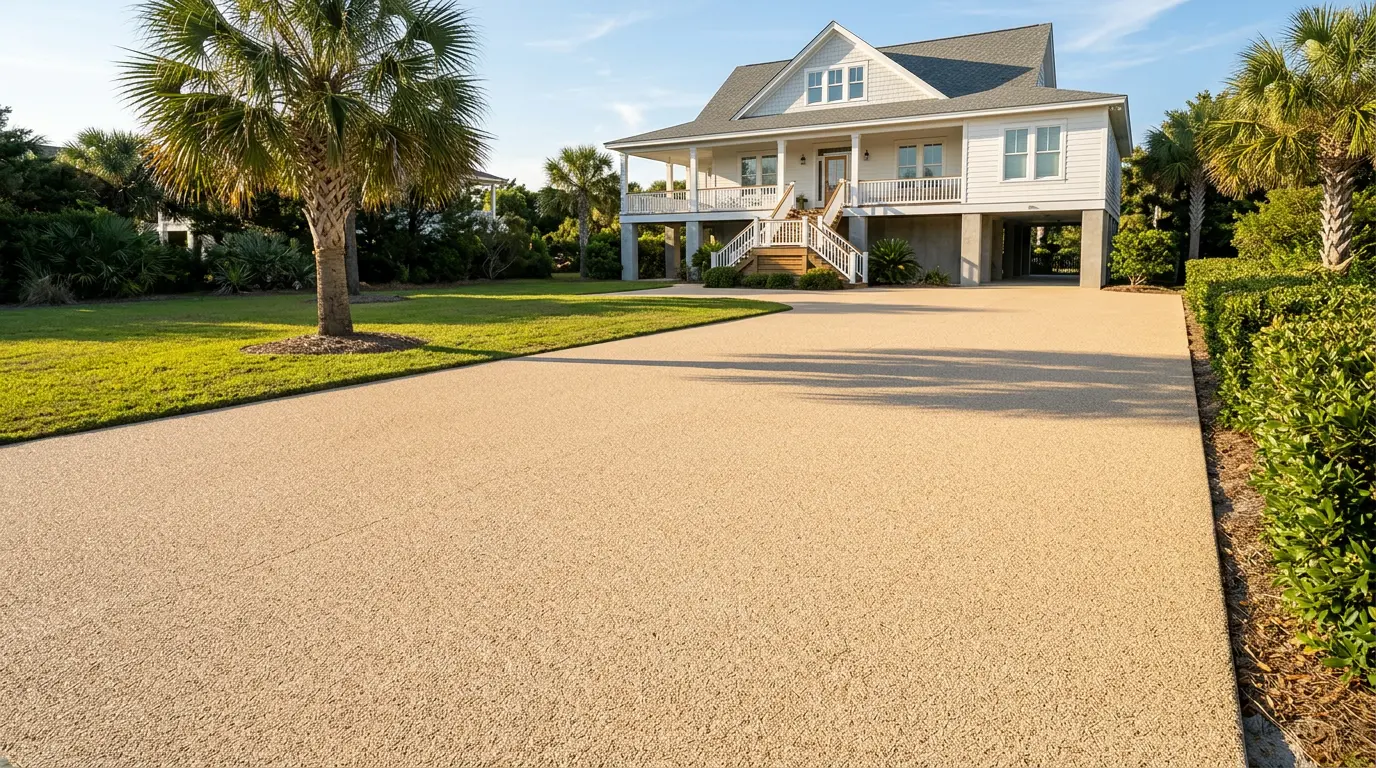
Resin-bound surfacing is made by thoroughly mixing aggregate — stone, gravel, or recycled glass — with a clear UV-stable resin, then laying it in a continuous bound layer over a prepared base. Every stone is coated and locked in place. There are no loose particles on the surface.
The result is a smooth, permeable finish that meets ADA accessibility requirements, complies with Clean Water Act drainage standards, and holds its color without sealing or retreating.
For coastal installations specifically, we specify aggregate blends and base systems designed for salt air exposure, high humidity, and the drainage demands of tidal properties. A system specified for inland conditions will not perform the same way here.
Installation
Two installation approaches. One right choice for your site.
OVERLAY INSTALLATION
Resin-bound surfacing is applied directly over your existing concrete — provided the slab is structurally sound and drainage is adequate. No excavation. No demolition. Faster timeline and lower disruption to the property.
Best suited for: driveways with intact slabs, properties where access is limited, renovation projects where the existing base has held well.
GROUND-UP INSTALLATION
Full excavation, engineered base construction, and resin bound surface installation from the ground up. Required when existing surfaces show cracking, heaving, or drainage failure — or when a new driveway is being built where none existed.
Best suited for: new construction, driveways with compromised concrete, properties with chronic drainage issues, and sites where grade correction is needed.
Our Process
Every resin bound driveway starts with an honest evaluation.
1
Site Assessment
We evaluate your existing surface, base condition, drainage patterns, and grade before recommending an approach. No quote is issued until we understand what’s beneath the surface.
2
Custom Specification
Your installation is specified for your site — aggregate blend, base build-up, edge detailing, and drainage integration. Not adapted from a standard spec sheet.
3
Certified Installation
Installed by a certified resin bound specialist with 25 years of experience constructing exterior surfaces in the Lowcountry and coastal Georgia.
4
Warranty Coverage
Every resin bound driveway we install carries a 20-year product warranty. Materials are sourced from manufacturers with documented performance data for coastal environments.
Why It Works Here
Built for coastal conditions. Not adapted for them.
UV Stable
Color does not fade, yellow, or chalk under direct sun. Structural integrity maintained through repeated UV exposure without retreating or resealing.
Salt Air Resistant
Aggregate and resin systems selected for resistance to salt air exposure and chloride penetration — the primary cause of surface failure on coastal properties.
Fully Permeable
Stormwater passes through the surface at a rate that meets or exceeds local drainage requirements. No pooling. No runoff to adjacent properties.
Zero Maintenance
Stormwater passes through the surface at a rate that meets or exceeds local drainage requirements. No pooling. No runoff to adjacent properties.
The Comparison
Resin bound vs. the alternatives.
| Resin Bound | Concrete | Asphalt | Pavers | |
|---|---|---|---|---|
| Permeable | Yes | No | No | Partial |
| Salt air resistant | Yes | No | No | Partial |
| UV stable | Yes | No | No | Varies |
| Maintenance required | Minimal | Moderate | High | High |
| Lifespan (coastal) | 20+ years | 8–12 years | 5–8 years | 10–15 years |
| ADA compliant | Yes | Yes | Yes | Partial |
Where We Work
Serving coastal South Carolina and Georgia.
We install resin bound driveways across the Lowcountry and coastal Georgia — including Isle of Palms, Sullivan’s Island, Daniel Island, Mount Pleasant, Charleston, Kiawah Island, Seabrook Island, Hilton Head, and surrounding waterfront communities.
Each location presents different soil conditions, drainage requirements, and salt exposure levels. Our specifications are adjusted for each site — not applied uniformly across all installs.
Ready to evaluate your driveway?
Every project starts with a site assessment. No pressure. No generic quotes.