
Resin Bound Surface Renovation for Coastal Driveways, Patios & Pool Decks
Transform an existing surface without demolition. Overlay installations engineered for salt air, UV exposure, and coastal drainage. Serving Isle of Palms, Sullivan’s Island, Daniel Island, Mount Pleasant, Charleston, and Hilton Head.
25
Years of Experience
No
Demolition Required
SC
Licensed & Insured
South Carolina
20
Year
Product Warranty
The Opportunity
Your existing surface may not need to be replaced. It may need to be renovated.
Full demolition and ground-up reconstruction is the right approach when a base has failed. But when the underlying concrete is structurally sound — when the slab is intact, the drainage works, and the problem is purely the surface — demolition is unnecessary, disruptive, and significantly more expensive than it needs to be.
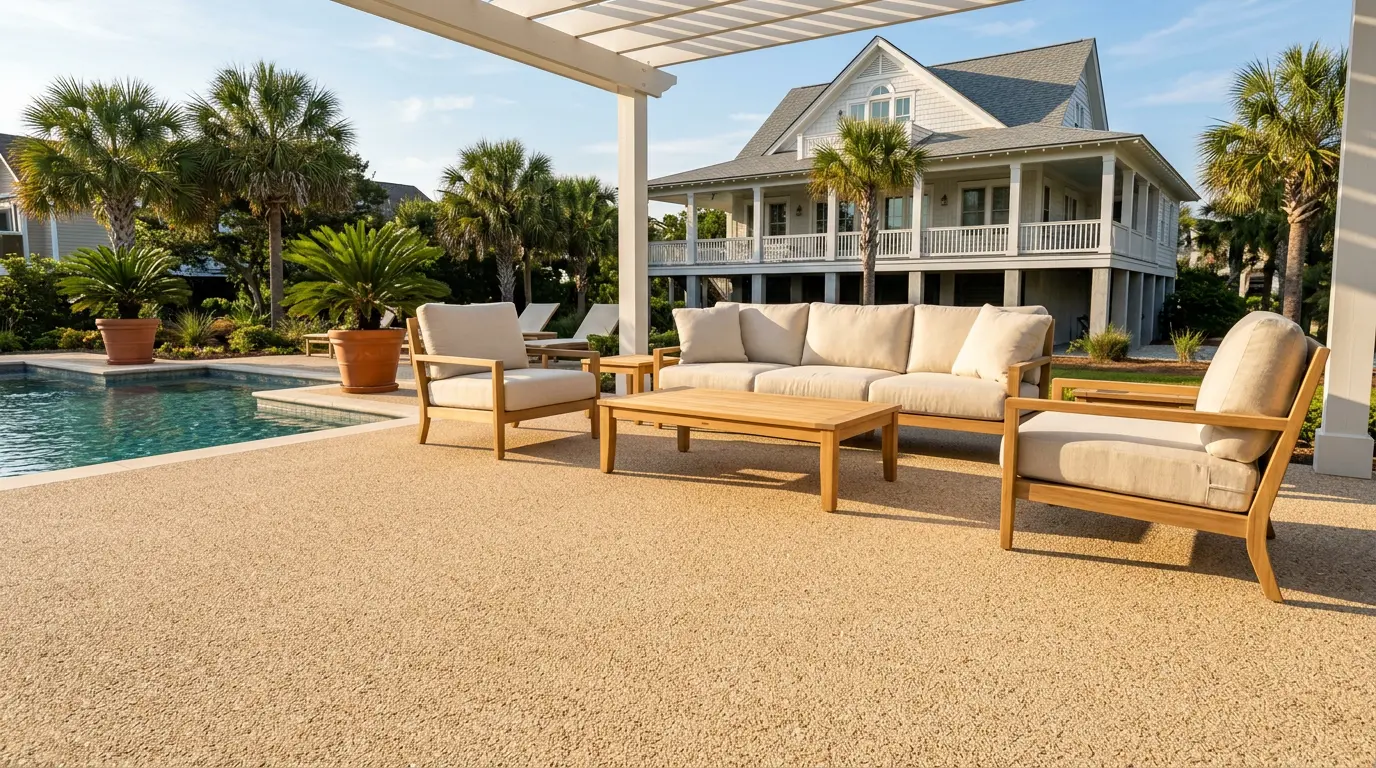
A resin bound surface renovation applies a new resin bound layer directly over the existing concrete. No excavation. No removal. No waste. The result is a fully bonded, permeable surface that performs to the same standard as a ground-up installation — at a fraction of the disruption and cost.
For coastal properties where access is limited, landscaping is established, and project timelines matter, an overlay renovation is often the most practical path to a new surface.
Sound Familiar?
The surface looks bad. The base underneath is fine.
These are the renovation situations we assess most — where full replacement isn’t necessary, but the existing surface needs to go.
“Our concrete driveway is stained and faded but structurally sound. Three contractors said to replace it entirely. We don’t think we need to.”
“The pool deck concrete is in good condition but it looks ten years old. We want a new surface without ripping out the existing slab.”
“We just had landscaping installed around the patio. A full demolition would destroy all of it. Is there an overlay option?”
“The driveway surface is peeling and pitting from salt air. The base is still solid — I had a structural engineer confirm it.”
“We’re selling the property and need the outdoor surfaces to look premium. We don’t have time for a full replacement project.”
“The existing concrete is fine but the color and texture are wrong for the property. We want something that looks intentional.”
Every one of these situations starts with an honest assessment. If the base qualifies, a resin bound surface renovation delivers a new surface without the disruption of full replacement.
How It Works
What a resin bound surface renovation actually involves.
A resin bound overlay installation begins with a thorough assessment of the existing surface. The concrete must be structurally sound, properly bonded, and free from active drainage failures before an overlay can be applied. If the base qualifies, the existing surface is cleaned, repaired at any weak points, and primed to accept the resin bound layer.
The resin bound mix — aggregate and UV-stable resin — is then applied in a continuous bound layer over the prepared base. Every stone is fully coated and locked in place. The result is a smooth, permeable surface that meets ADA accessibility requirements and Clean Water Act drainage standards — bonded directly to the existing concrete beneath.
The assessment is the most important part of this process. We do not recommend overlay installations on surfaces that won’t support them — that leads to delamination and premature failure. If the base doesn’t qualify, we’ll tell you, and explain what the ground-up alternative involves.
Is Your Surface Eligible?
What qualifies for a resin bound overlay — and what doesn't.
✓ Overlay is suitable when:
Existing concrete is structurally intact with no active cracking or heaving
Drainage is adequate — water moves away from the surface properly
Surface is cosmetically worn but structurally sound
No evidence of sub-base movement or settlement
Grade and edge conditions are appropriate for overlay depth
✗ Ground-up is required when:
Concrete shows active cracking, heaving, or structural movement
Drainage is failing — water pools on or under the surface
Sub-base has shifted or settled unevenly
Existing surface is delaminating or separating from the base
New surface is being installed where none currently exists
Our Process
Every surface renovation starts with an honest assessment.
1
Base Assessment
We evaluate the existing surface thoroughly — structural integrity, drainage patterns, bonding condition, and edge detail — before determining whether overlay is appropriate for your site.
2
Surface Preparation
The existing concrete is cleaned, repaired at weak points, and primed to accept the resin bound layer. Preparation is the most important factor in overlay performance and longevity.
3
Resin Bound Installation
The resin bound layer is applied in a continuous bound finish over the prepared base. Aggregate blend, depth, and edge detailing are specified for the site — not from a standard template.
4
Warranty Coverage
Every resin bound surface renovation carries a 20-year product warranty on materials. The installation is backed by 25 years of exterior surface construction experience on the coast.
Why It Works Here
Same performance. Less disruption.
No Demolition
Existing concrete stays in place. No excavation, no skip hire, no damage to surrounding landscaping or access routes.
Faster Timeline
Overlay installations complete significantly faster than ground-up replacements — less disruption to the property, shorter project window.
Coastal Specification
Resin and aggregate systems selected for salt air resistance, UV stability, and coastal drainage requirements — same as our ground-up installations.
20 Years Warranty
Full product warranty on all overlay installations. Performance backed by certified installation and coastal-specific material specification.
The Comparison
Resin bound renovation vs. other resurfacing options.
| Resin Bound Overlay | Concrete Reseal | Epoxy Coat | Paver Overlay | Full Replacement | |
|---|---|---|---|---|---|
| No demolition needed | Yes | Yes | Yes | Yes | No |
| Permeable surface | Yes | No | No | Partial | Yes |
| Salt air resistant | Yes | No | Partial | Partial | Yes |
| UV color stable | Yes | No | No | Varies | Yes |
| Maintenance required | Minimal | Every 2–3 yrs | Every 3–5 yrs | Moderate | Minimal |
| Lifespan (coastal) | 20+ years | 2–4 years | 3–6 years | 8–12 years | 20+ years |
Where We Work
Serving coastal South Carolina and Georgia.
We carry out resin bound surface renovations across the Lowcountry and coastal Georgia — including Isle of Palms, Sullivan’s Island, Daniel Island, Mount Pleasant, Charleston, Kiawah Island, Seabrook Island, Hilton Head, and surrounding waterfront communities.
Each renovation begins with an on-site assessment. We evaluate the existing surface in person before making any recommendation — overlay suitability cannot be determined from photographs or a phone conversation.
Not sure if your surface qualifies?
We’ll assess it in person and give you an honest answer. No pressure. No generic quotes.